Author: vsm-admin

  • SEXUAL VIOLENCE AGAINST WOMEN: A TIME FOR EVERYONE TO TAKE ACTION

    SEXUAL VIOLENCE AGAINST WOMEN: A TIME FOR EVERYONE TO TAKE ACTION

    Author: Olayemi Ajibola

    In the past couple of days, Nigeria has been rocked with various cases of sexual violence against women and girls, with these experiences ranging from horrifying to shocking. In Edo state, a 100-level student of the University of Benin, Uwaila Omozuwa, was raped and brutally assaulted while studying in a church, which led to her death two days later; in Jigawa state a 12-year old girl was raped by 11 men;  in Oyo state, Barakat Bello, an 18-year old student of the Federal College of Animal and Production Technology, was raped and killed; while in Ekiti state three armed men allegedly gang-raped a street hawker. The nature of these cases has led to protests and calls for justice for the survivors.

    The context of sexual violence in Nigeria becomes grim when one considers The United Nations International Children’s Emergency Fund report in 2015 which states that 1 in 4 girls and 1 in 10 boys in Nigeria experience sexual violence before the age of 18. The report further stated that of the children who reported violence, fewer than five out of 100 received any form of support. To address this problem as well as the shortcomings of the provisions of the criminal and penal code on rape, the Violence Against Persons (Prohibition) Act of 2015 (VAPPA) was enacted. A key feature of this legislation included elevating unlawful anal and oral sex to the status of rape, recognising gang-rape and setting a minimum penalty of 12 years imprisonment away from the judge’s discretion for the crimes. In addition to the VAPPA act, Nigeria launched its first sex-offenders registry in 2019. While these important legislative steps and initiatives to curb sexual assault and violence against women and girls are laudable, there is more work to be done to ensure society is safe for Nigerian women.

    On the institutional front, Nigeria’s law enforcement agencies, being the first point of contact for victims of sexual assault and violence, have to be re-educated on a humane approach to address sexual assault cases. There are cases of law enforcement agents making snide remarks at victims and their families, and demanding resources from victims to “mobilize and investigate”.  This behaviour discourages victims from pursuing justice and ensure culprits do not escape justice. Also, there has to be the availability of rape kits in every police station and hospital in the country, as this is the first step towards establishing a claim of sexual violation and getting justice for victims.

    The private sector also has a role to play in the fight against sexual violence against women and girls in Nigeria by actively collaborating and cooperating with development organisations to create programs that will lead to a shift in social norms. Through advertising, advocacy via monthly newsletters to customers, and media messaging, the private sector can influence social norms and behaviour that will help prevent sexual assault against women and girls. Also, businesses can partner with development organisations to develop workplace programs, policies and culture that address sexual assault against women and girls. There will be a ripple effect on society if many businesses in Nigerian can create workplace programs and set-up proactive policies to fight against sexual assault against women and girls.

    Development organisations in Nigeria must infuse sexual education within their activities, such as, what the Women-At-Risk-Foundation (WARIF) and the Mirabel Center is doing. A robust sexual education platform for young boys and men and the society at large will take Nigeria one step towards safety for women and girls. One of this approach could be the creation of a robust sexual education initiative targeting various communities with information on sex, sexuality, respect for human choice, defence tactics for women, behavioural change for men and so on. This information can also be developed in the local language of these communities to ensure the message is heard clearly and understood perfectly.

    Furthermore, the paucity of data on sexual assault and violence against women and girls in Nigeria is a problem that should be addressed by the government. The National Bureau of statistics should be empowered and funded to conduct surveys on sexual assault and violence against women and girls in each state to make it easy to contextualise the impact of various legislation and programs implemented by different stakeholders in the society.

    Making the society safe for women is a task that involves everyone, and for us at VS Management & Consulting (VSMC). We consistently seek collaborations and partnerships to enshrine sexual education in institutions and communities across Nigeria, with the overall aim of creating a sexual assault-free society.

    Let us work together to create a safe space for women and girls in Nigeria.
  • Empathy In A Challenging Time

    Empathy In A Challenging Time

    The COVID-19 pandemic has affected societies and individuals across different socio-economic divide, with many people losing their source of livelihood. Without any means of earning a living and with majority of Nigerians living below the poverty line, corporate organisations and individuals are taking responsibility by catering for the needs of the underprivileged, and working to reduce the negative impact of the pandemic on majority of the population.

    As development consultants, empathy is at the forefront of our work, and throughout the lifecycle of projects or programs, we will have to listen to project beneficiaries so we are able to provide services that can genuinely address their reality. Without empathy, comprehending a society’s needs will be futile. The common language that brings development expert and community leaders to a discussion table is empathy – the understanding that people’s lives could be better if certain structures are in place, the shared belief that a problem exists that needs to be solved, and the common resolve to address this problem by any means possible. It is this shared empathy that makes communities adopt a project as theirs, and which invariably contributes to the sustainability of a project or initiative.

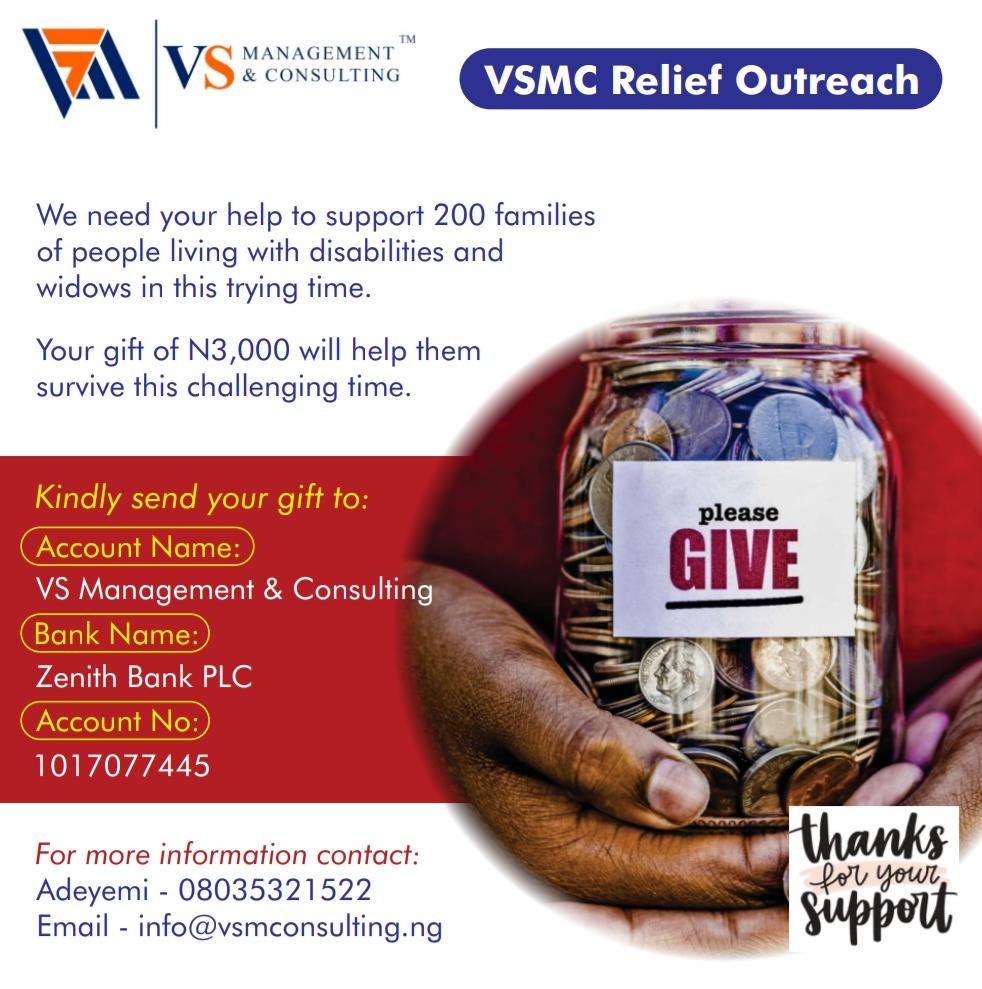
    Implementing a relief program during this challenging time is borne out of empathy for people who are in a disadvantaged situation, and whose plight will be greatly impacted by the pandemic. In line with the need help those gravely affected by the pandemic, we are embarking on a campaign to provide relief to 200 families of widows and persons living with disabilities in Lagos state, Nigeria. This group of Nigerians find themselves in the category of people with an urgent need for relief during this hard time, and it is vital to help as many as possible.

    Our approach recognizes that many people are looking for ways to make individual impact in this period but do not know the best approach to implement. Therefore, we arrived at a conclusion, after much deliberation, that the best way to involve as many well-meaning Nigerians as possible to achieve this cause is by crowdfunding. The campaign is expected to improve the plight of widows and people living with disability, and also give them a message of hope, care and love from Nigerians.

    If you want to help provide relief for 200 families of widows and people living with disability in Nigeria, please make a donation to:

    Account name: VS Management & Consulting

    Bank Name: Zenith Bank PLC

    Account No: 1017077445

    Or to https://paystack.com/pay/vsmcreliefoutreach

    All received donations will be duly accounted and reported on our website. Kindly contact Adeyemi on +2348035321522 or send an email to info@vsmconsulting.ng for inquiries.

  • Firm plans relief for 200 less-privileged amid COVID-19 Pandemic

    Firm plans relief for 200 less-privileged amid COVID-19 Pandemic

    The COVID-19 pandemic has affected societies and individuals across the different socio-economic divide, with many people losing their source of livelihood.

    In a bid to alleviate the ordeals of people with low economic power and a majority of Nigerians living below the poverty line, corporate organizations and individuals are taking responsibility by catering for the needs of the underprivileged, and working to reduce the negative impact of the pandemic on majority of the population.

    In line with the need to help those gravely affected by the pandemic, the VS Management & Consulting (VSMC) is embarking on a campaign to provide relief materials to 200 families of widows and persons living with disabilities in Lagos state, Nigeria. This group of Nigerians find themselves in the category of people with an urgent need for palliatives during this hard time, and it is vital to help as many as possible.

    VSMC recognizes that many people are looking for ways to make individual impact during this period, and will be adopting the crowdfunding approach thus making use of funds from well-meaning Nigerians to implement this project. The campaign is expected to improve the plight of widows and people living with a disability, and also give them a message of hope, care and love from Nigerians.

    If you want to help provide relief for 200 families of widows and people living with disability in Nigeria, please make a donation to:

    Account name: VS Management & Consulting

    Bank Name: Zenith Bank PLC

    Account No: 1017077445

    Or to https://paystack.com/pay/vsmcreliefoutreach

    For enquiries please contact Adeyemi – +2348035321522 or info@vsmconsulting.ng

    Reference : Topnaija.ng

  • A New Approach To Programme Design And Delivery In A Pandemic

    A New Approach To Programme Design And Delivery In A Pandemic

    Author: Olayemi Ajibola

    The world is currently battling a pandemic that has affected millions of lives and led to the shutdown of many sectors of the global economy threatening global prosperity and development. The impact of this pandemic is more pronounced in low and middle-income countries whose economy and governance structure is fragile and with the majority of the population living below the poverty line. 

    Many countries in Africa rely on programmes and activities of organizations in the non-profit sector to contribute to the development of their society but different Covid-19 containment measures by African governments have affected service-delivery from these non-profit organizations. Therefore, what lessons can development organizations glean from this sober period in human history to improve their programme design and delivery approach? 

    The Need For Community “Evangelists” And Transfer Of Knowledge:

    Many governments are adopting various containment measures to check the spread of the virus. Some of these measures include restricting the movement of people, closing educational centres, and imposing curfews, which have affected the activities of development experts. The key components to programme designs such as needs assessments, stakeholder engagement, monitoring and evaluation, piloting, and implementation have also been affected because the technical experts saddled with each aspect of these processes are unable to carry out their duties as a result of the containment measures. The uncertainty of this period should be seen as a call to development organizations to actively engage community evangelists and transfer knowledge crucial to implementing programmes to these community evangelists. 

    Devolving Decision-Making Centres:

    The current pandemic has affected many African communities disrupting the traditional approach to programme delivery by non-profit organizations. This approach concentrates decision-making to the top of the organizational hierarchy while leaving field workers, or community project leaders, without any decision-making power to influence service delivery. The pandemic has shown that development organizations should empower their community evangelists with some form of decision-making power as this could be a trigger to innovative thinking on project delivery. It will also mitigate against suspending crucial intervention to these communities should a similar COVID-19 pandemic occur in the future. Devolving decision-making centres will also allow recipient communities to further own a project and see to its successful implementation.  

    Embracing Technology To Accelerate Development Initiatives:

    The Covid-19 pandemic has led to a global embrace of technology, with many organizations working remotely and coordinating organizational activities online. Development organizations have also moved their processes online, but there are key processes that cannot be moved to the “cloud”. Introducing technology to the programme design process is vital for continuous synergy between development experts and community evangelists. It ensures a continuous implementation of programmes and preserves the quality of the intervention while maintaining operational efficiency and effectiveness. There are different ways development organizations/non-profits can leverage technology for impact especially during a pandemic. They can explore virtual technologies to inform, engage and update supporters and shareholders; adopt tools to remotely manage databases so as to keep track of project progress; and take advantage of mobile messaging to reach project beneficiaries with important information about service delivery.  

    Lastly, by thinking proactively and innovatively, there are opportunities for development organizations and non-profits to improve their programme delivery approach while making social-impact in unprecedented ways. In line with the need to be in tandem with current happenings, the VS Management & Consulting is committed to ensuring non-profits can take advantage of this perilous time by preparing them to think innovatively; as this will be a major requirement for survival in the post-COVID world.